Research conducted by the National Bank of Australia found that Australian citizens are willing to share more personal information with their bank if it helps stop suspicious payments.
Customers are more savvy now when they receive bogus text messages and calls from scammers compared to a year ago, the research also showed.
This enables customers to have a genuine and open line of communication with their bank, as traditional trust anchors, to provide their biometrics to assist in facilitating payment alerts targeted at scammers.
Customers warned of giving their information away to scammers, who often impersonate bank employees, should understand how their bank will communicate with them to obtain their biometric data, used to protect verifiable app payments.
Banks are cracking down on fraudsters intercepting genuine email and text communications to customers as well as impersonating bank phone numbers.
NAB have been expanding payment alerts in their business banking digital platform and recently introduced behavioural biometrics to better understand how genuine customers interact with the app versus fraudsters.
A third of Australians said they would prefer banks to slow down payment onboarding processes to protect them from a scam. Four out of ten survey participants expected their bank to warn them if a payment looked suspicious. The most common scams affecting Australians, which incurred $434 million costs in 2022, are invoice and romance scams.
NAB announced they would be expanding these alerts and “a customer may receive one if our fraud system detects a potential invoice or romance scam payment.” While reports of these scams have increased, actual losses in fraudulent payments have reduced by 25% for the period between October and December in 2023.
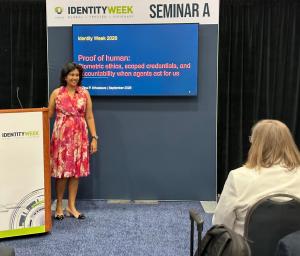
The National Bank of Australia (NAB) was a speaker at Identity Week Asia 2023.