Every structure or entity in the distribution supply chain should have a unique identifier to navigate B2B trade with larger entities such as airlines.
As a new year begins, it is a good time to re-evaluate decentralised identities in the modern Business-to-Business environment, as well as B2C, and address whether physical distribution procedures have been converted to digital data exchanges and workflows.
The World Economic Forum states all supply chain actors “benefit from a consistent reference to established identifier standards which provide systematic identification of subjects” to help organisations manage their suppliers and distributions with the data.
Identifiers – created through the use of verifiable credentials – are what allow the components of the supply chain for example, the products, persons, carriers or physical or digital trade document to be aligned with an ID to integrate secured data within an organisation or between parties.
In April 2022, in an article on IATA airlines it claimed New Distribution Capability (NDC) technology was state-of-the-art to define airline supply chains with the implementation of a decentralised identity data management system. Unique ID’s for all business partners were described as catapulting the travel industry far into the future with a format to see airlines evolve into retailers and take control of the supply of modern infrastructure available.
Airlines have succeeded with enhancing distribution value chains now to enable the installation of world-class biometric touchpoints, e-gates and systems from end-to-end of the passenger experience. They have also achieved a decentralised approach for customers to input their personal and flight data into a digital app to share with the airline and authorities before they travel.
A WEF paper published in 2019 corroborated the need for sector supply chains to make a radical change, explaining that most identity systems were silo and lacked interoperability.
“Different public and private solutions record and maintain identical identity data potentially hundreds of times over, and are not interoperable, creating a significant amount of redundant identity information.”
The identifiers that exist today indicate the growing visibility of supply chains and data to unlock potential “great advantages for trade partners as they participate in the global economy and international trade”.
Many airlines display or have undergone the modern technology renovations from installing biometric systems to eliminating paper documents.
While being a solution to reduce fraud, airline supply chain is naturally complex and further growth can also perpetuate data attacks, however airlines must be better poised to identify threats through digital transformation.
The graph (DOCRadar) shows the fluctuating daily distribution of (DDoS) attacks affecting the aviation industry in 2023. Supply chain attacks are still a serious vulnerability for the aviation industry given the number of supplier and vendor partners it relies upon for infrastructure.
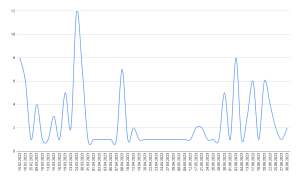
On June 23, DOCRadar reports that American Airlines and Southwest Airlines were both affected by a data breach on a third-party software, Pilot Credentials, which held information about candidates during a pilot and cadet hiring process. Other attacks included a breach on a file transfer software called MOVEIT which affected Dublin Airport Authority (DAA).
The attacks may indicate that the travel and other sectors still need to invest in data management systems with decentralised identifiers.
IATA has implemented a programme called Digital Identity for Distribution which enables secure identification of organisations involved in their distribution chain. The programme is built upon open standards such as the W3C’s Decentralized Identifiers and Verifiable Credentials standards.
IATA said it plays a key role in “supporting the aviation industry to operate more effectively by providing different players with codes and identities commonly recognized across the value chain, for example the IATA airline designators (e.g., AF), location codes (e.g. CDG), and IATA agency codes”.
IATA – Digital Identity for Distribution