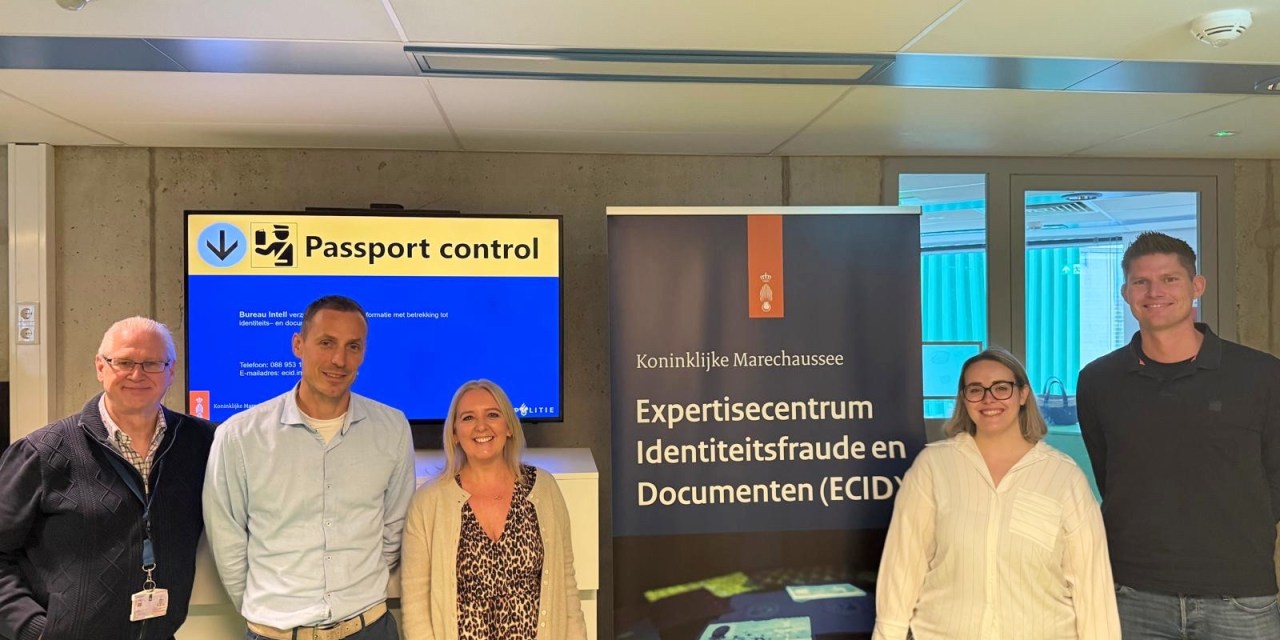
Matty Shafran, Senior Conference Producer for Identity Week Europe conducts interview with: Jurgen Meijer, Policy Advisor at the Royal Marechaussee; Rob Schotman, Innovation Officer; Doron Wallin, Spokesperson for the Royal Marechaussee, including ECID; and Hans de Moel, Staff Advisor COC2
How the Identity Fraud and Documents Centre of Expertise (ECID) safeguards borders and trust in identity systems.
In an era of digital passport pilots, chip technology, AI-generated forgeries, and seamless travel systems, the Royal Netherlands Marechaussee’s Identity Fraud and Documents Centre of Expertise (ECID) stands as one of Europe’s most advanced lines of defence against identity and document fraud. Operating as both a technical powerhouse and a national advisory body, ECID’s mission is simple yet critical, as put by Jurgen Meijer, Policy Advisor at the Royal Marechaussee: “We work together on an effective approach against identity and document fraud, and our vision is to continuously develop knowledge, expertise, innovation, to optimise the international and national fight against identity and document fraud.”
Since the birth of Secure Document World and the evolution of Europe’s largest identity event, Identity Week Europe, it has been the privilege of the Identity Week team to partner with ECID and the Royal Marechaussee at Identity Week Europe to ensure that this collaboration continues as documents and forgeries evolve. Recently, we visited the Royal Marechaussee barracks in Badhoevedorp for an in-depth look at ECID’s facilities and commitment to document authentication and examination. Welcomed by Erik van Assen, Head of ECID; Jurgen Meijer, Policy Advisor; Rob Schotman, Innovation Officer; Doron Wallin, Spokesperson for the Royal Marechaussee, including ECID; and Hans de Moel, Staff Advisor COC2, we explored ECID’s mission and the future of document examination.
A National Hub for Document Integrity
Founded to strengthen the country’s capacity to detect and prevent identity fraud, ECID is a cooperative arrangement between and the Netherlands police force and the Royal Netherlands Marechaussee, the Dutch military police responsible for border security and identity control, through cutting-edge expertise and collaboration.
Headquartered in the Netherlands with the Forgeries Desk (FSD) at Schiphol Airport, a forgery desk in Ter Apel and regional ID-desks in Badhoevedorp, Rotterdam, Eindhoven, and Zwolle, ECID has around 100 employees, including a number of document experts. Its reach extends beyond law enforcement to primarily other government departments that turn to ECID and the Royal Marechaussee for authentication, verification, analysis, and advice.
The border process at Schiphol Airport for authenticating and verifying a document is divided into three lines of defence. When a first-line officer at the border questions a traveller’s document, second-line experts can assess it within minutes in the back office, often even third line examination is possible through an innovative tube system at Schiphol Airport that transports questionable IDs directly to an ECID officer at the FSD, that is a document expert. If a document is confirmed as fraudulent, the traveller is detained, investigated, brought before a judge, and, depending upon circumstances, jailed before being returned to their country of origin.
Defining ‘Document Excellence’
At ECID, document excellence isn’t just about authentication; it’s about intelligence, innovation, and knowledge-sharing. ECID maintains a national and international information network that monitors emerging fraud trends, issues alerts, and provides technical updates across government agencies. It’s no secret that fraud is evolving faster than ever. ECID is not only focusing on catching the users of fraudulent documents but on actively identifying and disrupting the people who produce them. In simple terms, catching the forger, not just the user. This proactive approach has seen ECID expand from verification to full-scale intelligence and investigative operations, supported by continuous training and advanced inspection systems.
The Science of Verification
Every document that arrives at ECID, whether a physical passport or a digital scan, is treated as an object of investigation. Document experts use high-tech scanners and chip analysing software to examine the biometric chips almost to a forensic level. ECID also houses a full passport library, containing different specimen passports from around the world for reference, comparison, and training. The ECID, updates the content of several document systems in cooperation with other agencies, like the online resources for passports and travel documents at https://www.edisontd.nl, but also https://www.consilium.europa.eu/prado/en/search-by-document-country.html. These resources compile travel documents from around the world for the general public as well as experts to digitally access and further their own knowledge.
For digital images, the challenge is even greater. ECID experts assess whether scans have been AI-generated, manipulated, or composited, a task that requires both technical tools and deep human expertise.
All Marechaussee personnel receive a baseline training in documents (DOC1). Some enthusiasts will be trained further to become a document second-line examiner (DOC2). To work as a document expert at the ECID they have to pass the training for experts (DOC3). This team trains continuously to stay ahead by following additional courses on new printing techniques (Eye of the Master, New Digital Printing Techniques) or new developments like RFID and PKI technology, such as provided by Cor de Jong and Jeen de Swart of Justid, the Netherland’s Ministry of Justice and Security. In 2023, Jeen de Swart opened Identity Week Europe with a speech covering PKI and chip technology.
Balancing Innovation and Security
While technology has revolutionised border control and continues to improve passenger flow, ECID remains cautious about fully automated systems. Crossing a border is so much more than simply verifying traveller identities; questions like “why are you travelling, where from, who with?” are essential to ensure national and European security. These are questions that are asked to people who come from outside Schengen and want to enter the Schengen area. Also called Third-country nationals (TCNs). Hans de Moel, Staff Advisor and Former Innovation Officer at the Dutch Ministry of Defense simply said, “How do you detect intent? It’s only through interacting with people.”
Testing is central to ECID’s philosophy. The Centre rigorously trials e-gates and biometric systems before deployment, ensuring accuracy across passport types and preventing authentication errors that could compromise security. “If you don’t have any errors or issues, you’re not doing it right”, said Rob Schotman, Innovation Officer at ECID. This extends to the use of scanners and biometric equipment; low error rates can be a red flag to ECID officers. The team also warns that long-validity passports and quantum computing could pose new risks if not matched by future-proofed design and chip technology.
Evolving Threats in a Digital Age
AI-generated photos, deepfakes, and morphing are now at the forefront of identity crime. What was once the domain of organized forgers has become accessible with off-the-shelf tools and materials. Another example; “Polycarbonate and laser engraving used to be inaccessible,” says Rob Schotman. “Now, you can replicate these from around €250.” To counter these threats, ECID advocates for live enrolment – in-person identity verification that ensures authenticity at the point of issue. This model is in the process of being adopted in Germany and drives home the importance of in-person KYC for passport issuers around the world. The team also warns about digital entry-exit systems and digital passport stamps: while they streamline travel, they can reduce transparency across borders. “A physical passport with physical stamps is self-sovereign information [for the traveller] to give to a border guard. Now, the information will stay within Europe, or any other country that holds national databases. with no shared history and no shared knowledge. If you share the digital version, anyone can copy it” said Schotman.
Training, Trust, and Global Collaboration
ECID’s influence extends well beyond Dutch borders. Its experts conduct tailored trainings around the world, often adjusting materials in real time as new forgery techniques emerge specific to each location.
Within Europe, ECID has an advisory role in legislative discussions on the Digital Travel Credential (DTC), ensuring that innovation aligns with security. ECID and the Royal Netherlands Marechaussee also participate in ICAO working groups to shape global standards for identity verification.
A Call for Public Awareness
Despite ever-advancing identity and security technology, ECID reminds the public that identity security starts with simple habits. Thousands of lost or damaged passports pass through its offices, each one a potential vulnerability. Even a single lost passport can end up facilitating serious crime. ECID examines these lost document; many drop out of pockets or are left on trains.
Document holders also deface passports with souvenir stamps, intense wear and tear on the pages and covers, and even cut pages for personal convenience. Between document loss and damage, ECID stresses that caring for personal identity documents is the first step to preventing theft and misuse.
Looking Ahead
The future of document examination will merge the physical and digital, from AI-assisted authentication to blockchain-backed credentials. ECID remains cautious yet curious, testing every innovation before trusting it. Above all, ECID continues to prioritize collaboration: between agencies, nations, and citizens. As Jurgen Meijer of ECID puts it, “We work together on an effective approach against identity and document fraud.”
Through vigilance, expertise, and shared knowledge, ECID ensures that trust remains the most powerful security feature of all.