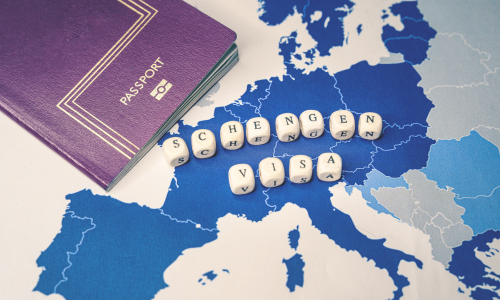
It’s 30 years today since the Schengen Area was founded on the principle of enabling free movement between EU member states.
On the 30th anniversary, the Schengen Area is very topical in light of the recent operation of the Entry/Exit System, a new digital border management system led by the European Union.
And at each delay in bringing the EES to fruition, the Area has been associated with the effort to register biometric data of non-EU nationals crossing territory borders across 29 countries. Today, freedoms for travel cannot be asserted without security and identity verification systems that are adapted to today’s threat landscape. The EES is one example of technological developments that has led to the EU provisioning more advanced IT infrastructure.
The new Entry/Exit System started to be operational on 12 October 2025 and will be adopted gradually until April 2026.
Strong authentication safeguards must be in place to allow free mobility, as legislation through the years has shown. A decade ago, France’s specific legislation criminalised fraudulent documents used to cross borders or access administrative services illegally.
Advances in border control technology are reshaping how Europe manages its frontiers, especially with the onset of automated biometric data collection and digital tracking at the EU’s external borders. This data is funnelled into EU information systems that promote interoperability with other existing systems. this represents a new approach: more responsive, more accurate, more integrated.
Jérôme Frou of Linxens Government, a global industrial group with over 40 years of experience in developing more secure identity documents, explains:
“It’s not about building invisible walls around Europe but about ensuring that every border crossing is based on an identity that is authenticated, verified, and protected. A modern border should not be an arbitrary filter, but a trusted interface. When it comes to mobility, security is not an obstacle – it’s the essential condition.”
As migration flows grow more complex, identity documents become high-tech objects, and the risk of misuse increases, but the priority remains to keep this symbolic space accessible without making it vulnerable.